Freelance editor vs agency vs in-house: which one you actually need
The right answer is set almost entirely by how many videos you publish a month, and how many formats you publish them in. Everything else is detail.
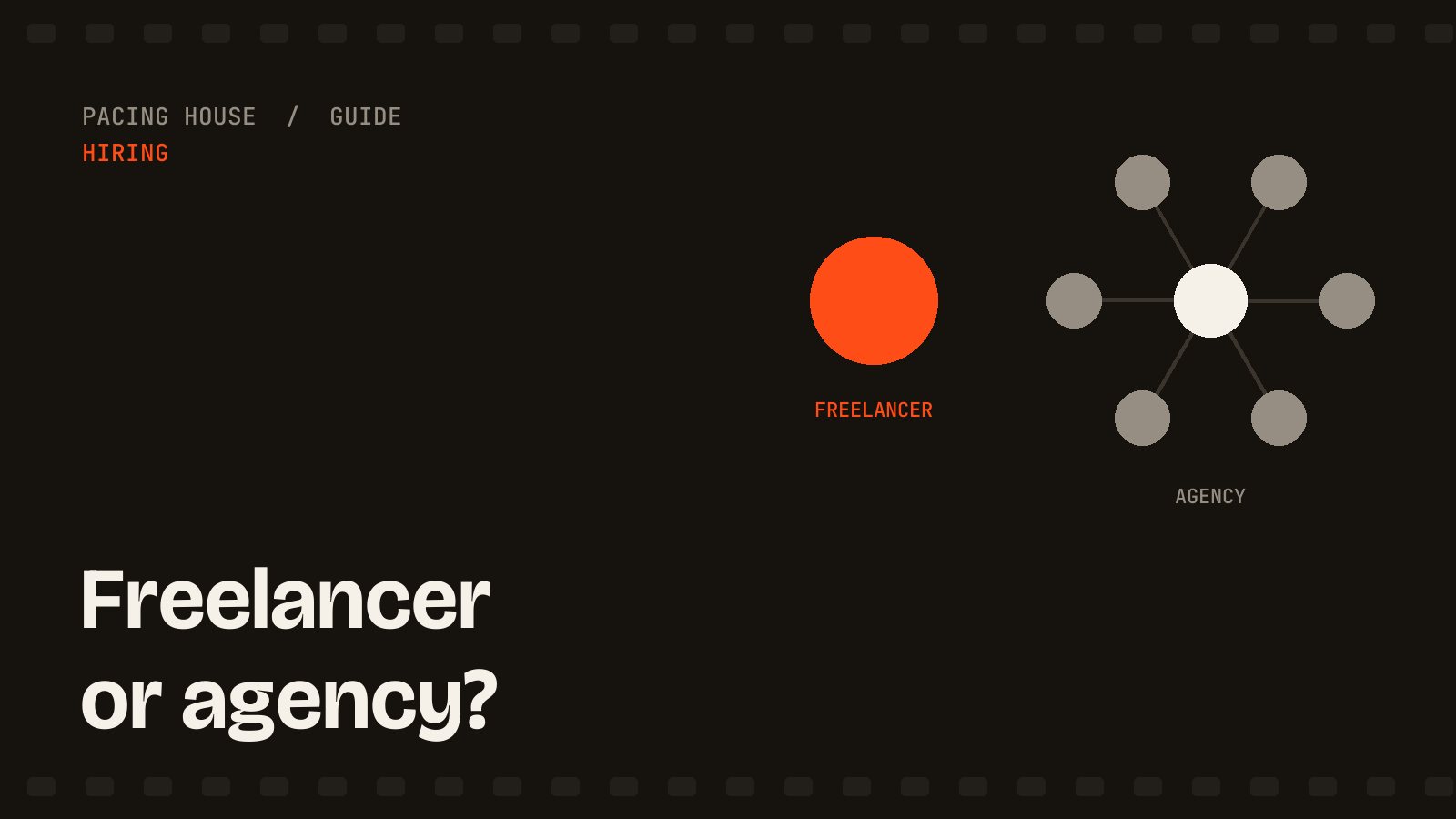
Declare the bias up front: I am a freelance editor, so I have an interest in one of these three answers. I have also watched creators hire the wrong model for their volume and waste a year on it, which is worse for everyone including me. Here is the comparison I would give a friend.
How the three models actually differ
Freelance editor
One person, working per video or on a monthly retainer. You talk to the person doing the work, so feedback arrives without a layer of translation and the style stays consistent because it is one pair of hands. Costs scale linearly: ten videos costs roughly twice what five does. For what the rates look like in practice, see how much a freelance video editor costs.
The exposure is obvious and worth naming: one person gets ill, takes holidays, or picks up a bigger client. A good freelancer manages that with notice and a backup; a bad one disappears mid-project.
Agency or production studio
A team with a project manager between you and the editors. You are buying capacity and continuity rather than a person. They absorb volume spikes, cover holidays, and can run several formats in parallel.
You pay a substantial multiple of freelance rates for that, because you are funding overhead, management and margin. The editor who actually cuts your video is often junior, often rotating, and you rarely speak to them. Consistency depends on how well the agency documents your style, which varies enormously.
In-house editor
An employee. The highest fixed cost and the deepest understanding of your brand — they sit in your meetings, learn your references, and stop needing briefs after a few months.
The true cost is not the salary. It is salary plus payroll taxes, software licences, hardware, storage, and your own time spent managing someone. An in-house editor also needs enough work to stay busy, and idle salaried time is the most expensive editing there is.
Choose by volume
This is the part that decides it. Be honest about what you actually publish, not what you intend to.
- 1–4 long-form videos a month: freelance, per video. An agency's minimum will dwarf the work and an employee would be idle most of the month.
- 4–8 videos, or long-form plus consistent Shorts: freelance on a retainer. You get priority in their schedule and a predictable monthly number, which is where most serious creators land.
- 8–20 videos across several formats: either a small team of freelancers, or an agency. One person cannot absorb this without quality slipping.
- Daily publishing, or a brand with continuous production: in-house, usually alongside a freelancer for overflow.
What each model gets wrong
- Freelance: single point of failure, and capacity ceilings that arrive without warning.
- Agency: you pay senior rates for junior hands, and your notes pass through someone who did not open the timeline.
- In-house: a fixed cost that does not shrink in a quiet month, plus recruitment risk if the fit is wrong.
The thing that matters more than the model
Whoever you hire, the first project decides the next two years. Run a paid test on one real video before signing anything longer. Give the same brief, the same footage and the same deadline, then judge three things: did they hit the deadline, did they follow the brief, and how did they take revision notes.
A paid test costs you one video's budget and tells you more than any showreel, because a showreel is their best work with their chosen footage. It also protects you from the most expensive mistake here, which is not picking the wrong model — it is committing to a long retainer or a salary on the strength of a portfolio.
If a retainer is where you are landing, this is what I do, on US, UK and AU hours. Start with one paid test cut and decide afterwards.